
Not All Offshoring Is the Same: Understanding Your Options Before You Hire Internationally
For a company hiring internationally for the first time, one of the most confusing parts of the process is that nearly everything gets described with the same handful of words. Outsourcing, offshoring, international staffing, virtual assistants, contractors, BPOs, and employer of record services are often discussed as though they are variations of the same product. They are not, and choosing the wrong structure can create significantly more work for a company than the executive team expected.
The easiest way to understand the market is to stop thinking about international talent as a single service. What you are really deciding is how much responsibility your company wants to retain for finding the person, employing them, managing their workplace, supporting their technology, ensuring compliance, and dealing with problems when something goes wrong. Different international hiring models move those responsibilities between you, the employee, and the company helping you hire.
That difference becomes important very quickly. Hiring an excellent professional in another country is only one part of successfully employing them. Someone also needs to recruit that person, understand the local employment market, manage payroll and benefits, provide reliable infrastructure, handle employment requirements, support the employee, and create a structure that allows them to work effectively with the US team.
For companies doing this for the first time, the employee is often the simplest part of the equation.

The Independent Contractor Model
The most accessible version of international hiring is usually the independent contractor. A company finds someone through a freelance marketplace, referral, LinkedIn, or recruiting website and contracts with them directly. For project work or highly specialized short term needs, this can be a perfectly reasonable solution.
It is also the model where the American company assumes much of the operational responsibility. You need to determine whether the person is actually qualified, establish how they will be paid, decide how equipment and data access will work, and understand whether the working relationship is legally structured as a contractor under applicable rules. If the person disappears, their internet fails for three days, or their work environment becomes unreliable, there may be nobody locally responsible for solving the problem.
This does not mean international contractors are unreliable. There are excellent independent professionals all over the world, just as there are excellent freelancers in the United States. The issue is that you are hiring the person without necessarily acquiring any of the infrastructure surrounding them.
For some businesses, that is exactly what they want. For others, they eventually discover that what initially appeared to be the simplest option has turned one of their managers into an international recruiter, HR administrator, IT coordinator, and compliance researcher.

The Traditional Outsourcing or BPO Model
At the other end of the spectrum is traditional business process outsourcing. Rather than hiring an individual, a company contracts another company to perform a function. The provider may operate customer service, data processing, collections, technical support, or another defined business process using its own employees and management structure.
This can work extremely well when the objective is to transfer responsibility for a complete process. The client cares primarily about service levels and outcomes, while the provider decides how many people are required and how the work is managed. That reduces the client's management burden, but it can also create distance between the people performing the work and the company they are supporting.
The person answering a customer's question may work across multiple accounts or follow a tightly defined process without becoming deeply integrated into the client's organization. That is not necessarily a weakness because it is simply a different model. If you want to outsource a function, a BPO may be exactly what you need.
The distinction becomes important when what you actually want is an employee. If you want someone who attends your meetings, learns your business, develops relationships with your staff, understands your customers, and becomes part of your institutional knowledge, outsourcing the process and building an international team are two different objectives.
The Employer of Record Model
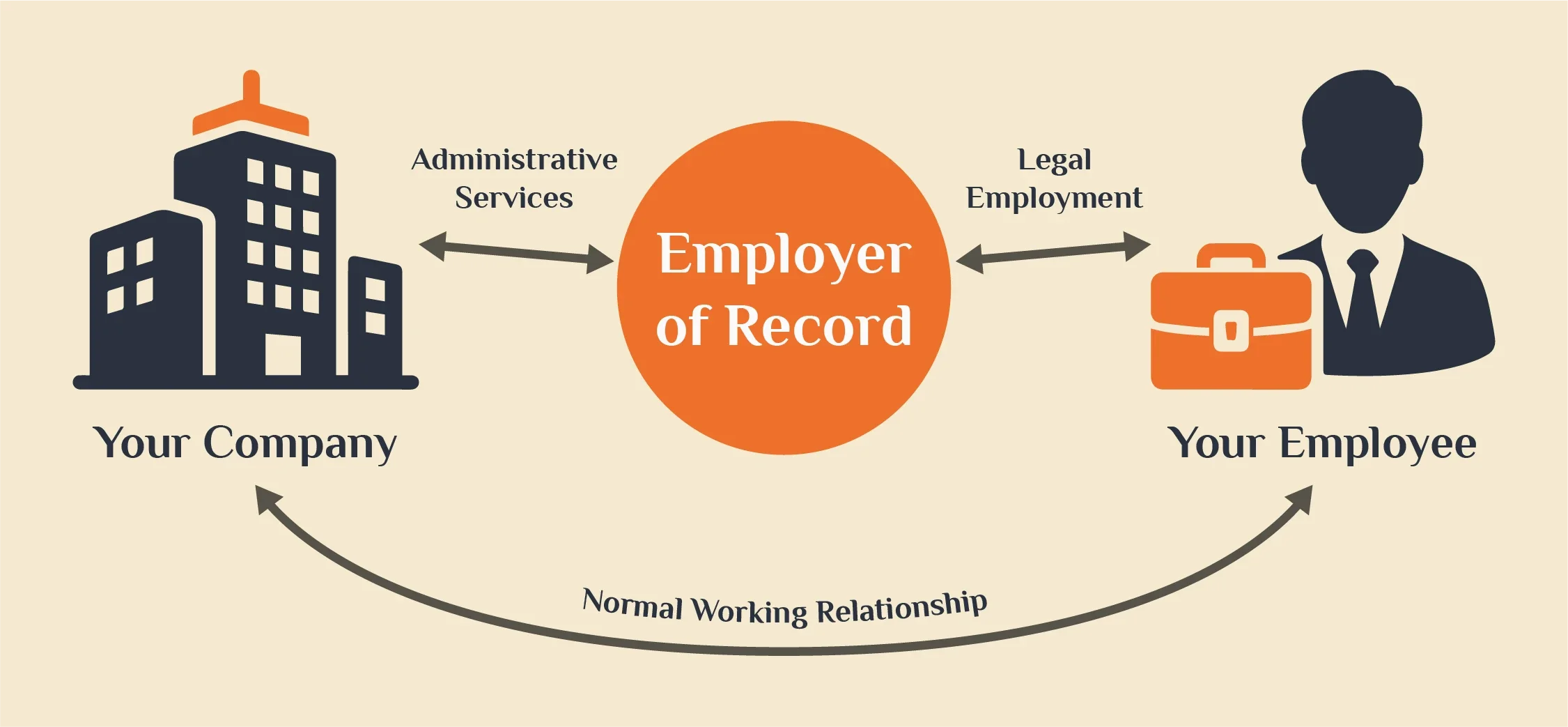
An Employer of Record, commonly called an EOR, solves another piece of the problem. The EOR provides the legal employment structure in the employee's country, allowing a US company to employ someone internationally without establishing its own local corporation. The EOR generally handles payroll, required benefits, employment contracts, and the administrative requirements associated with local employment.
This is an important service because international employment law is not simply American employment law translated into another language. Each country has its own requirements concerning compensation, leave, holidays, benefits, termination, taxation, and employee protections. A company that does not understand those rules can create liability without realizing it.
What an EOR does not necessarily provide is the rest of the operating environment. Depending on the provider, your company may still be responsible for finding the employee, assessing the candidate, providing equipment, supporting technology, managing performance, and determining where that person will work. You have solved the employment infrastructure question, but you may not have solved the talent or operational infrastructure questions.
For companies that already have experienced international recruiting and management teams, that can be enough. For a founder hiring their first two employees in another country, it can still leave a surprising amount of work on their side of the table.
Building Your Own International Operation
Larger companies sometimes take the final step and establish their own legal entity in another country. They lease office space, hire local management, build an HR function, contract payroll providers, establish recruiting relationships, create IT infrastructure, and employ their international workforce directly. At sufficient scale, there are circumstances where this structure makes strategic and financial sense.
The challenge is that you are now opening another company operation in a country where you may have never previously done business. You need to understand the labor market, compensation expectations, employment laws, recruiting channels, office requirements, local management culture, and the less obvious realities that only become apparent after operating there. The savings associated with international labor do not make those responsibilities disappear.
That investment makes sense when international operations themselves have become a major organizational competency. It makes considerably less sense when what you actually wanted was five excellent people supporting your finance, marketing, or customer service department. There is a point where building the infrastructure costs more attention than the initial staffing problem deserved.
This is the gap Turnkey Offshoring was designed to fill.
A Dedicated Employee Without Having to Build the Country Around Them
Turnkey's model is built around dedicated international employees who integrate directly into the client's organization while Turnkey provides the infrastructure surrounding them. We help design the role, recruit and vet the candidate, employ the person locally, provide the workplace and technology infrastructure, and handle the employment administration required in the Philippines. The client gets someone who operates as part of their team without needing to independently construct an international employment operation.
That distinction is important because our objective is not to take the business process away from you. Your employee works inside your systems, follows your procedures, communicates with your team, and develops knowledge about your organization. You retain control over what the employee does while Turnkey manages much of what makes employing that person internationally possible.
For the client, the experience should feel much closer to hiring an employee than purchasing outsourced labor. For the employee, there is a real workplace, local support, coworkers, benefits, management resources, and a company in their country responsible for their employment. Turnkey sits between the two sides to make that relationship work rather than simply making the introduction.

Why We Prefer an Office
One of the decisions we made early was that international employment should not automatically mean work from home. Remote work can be successful anywhere in the world, including the Philippines, but an international work from home model introduces variables that a US executive may have very little ability to observe or control. Residential internet quality, backup connectivity, power reliability, equipment standards, workspace privacy, household interruptions, and data security can vary significantly from one employee to another.
That variability becomes much more important when the person is responsible for customers or business critical systems. A manager in the United States should not need to troubleshoot why an employee thousands of miles away has been offline for three hours or determine whether the problem is a regional outage, home router, computer, or local power issue. Even if the employee is doing everything right, there are operational problems they cannot personally solve.
Turnkey's primary model places employees in our office in Davao City, where the working environment can be professionally managed. The office provides infrastructure such as reliable connectivity, power backup, security controls, and onsite support, while Turnkey's local management team is physically present with the employees. Our technical team can also work directly with the client's IT staff on VPN access, device restrictions, permissions, and other security requirements before the employee begins working.
There is also a human advantage to putting people together. New employees have coworkers who can answer questions, managers who can recognize problems, and an actual professional culture around them. If someone is struggling, disengaged, confused, or having a technical problem, there is someone in the same building who can see it.
Remote work is available when the role or client requires it, and there are situations where it makes sense. We simply do not believe that asking someone to work from their bedroom on the other side of the world should automatically be considered equivalent to providing a professionally supported workplace. For a business buying international talent for the first time, eliminating that variable creates a much more predictable starting point.
Recruiting Internationally Is Work
The next part of international hiring that companies underestimate is talent acquisition. Finding candidates in another country is not simply posting an American job description on another country's job board and waiting for less expensive resumes to arrive. You need to understand what qualifications mean locally, which schools and employers produce strong candidates, what appropriate compensation looks like, how applicants communicate, and what characteristics tend to predict success working with a US company.
Then someone has to actually do the recruiting. Applications must be reviewed, candidates screened, interviews conducted, employment histories considered, compensation aligned, and technical capabilities evaluated. If you are hiring internationally because your existing leadership team already lacks capacity, assigning that work to the same overloaded managers defeats part of the purpose.
Turnkey takes on that acquisition process because we already operate inside the market. Our recruiting team sources and vets candidates against the specific role we design with the client, including communication ability, experience, technical capability, and cultural fit. We maintain relationships within professional communities and the local talent market rather than asking the client to learn an entirely new recruiting ecosystem for every international hire.
That saves more than recruiting fees. It saves executive attention.
A US manager can certainly spend weeks learning the Philippine employment market, sorting through applicants, conducting first round interviews, researching salary expectations, and figuring out which credentials matter. The question is whether that is a good use of that manager's time when an existing team can perform those functions and present a smaller group of qualified candidates for the company to evaluate.
The client should still choose the employee. We want the US manager to interview candidates and decide who they want on their team because the relationship needs to work for both sides. The difference is that leadership spends its time choosing between qualified people rather than spending its time finding them.
Compliance Should Be Understood Without Becoming Your New Specialty
International compliance creates a similar challenge. A responsible executive should understand the basic employment environment in any country where their company has people working. You should know that employment laws differ, benefits work differently, local holidays matter, and American assumptions about hiring or termination cannot simply be exported around the world.
You should not need to become an expert in Philippine employment law just because you hired an accountant in Davao.
Turnkey's employees are employed locally through Turnkey, and our structure handles the HR, payroll, benefits, and employment administration surrounding those positions. We educate clients about the parts of the local employment system that affect how they manage their team, then we handle the local administrative and compliance work behind it.
That balance is important. We do not want international employment to feel mysterious because executives should understand the rules affecting their people. We also do not believe a CEO should spend an afternoon researching statutory Philippine employment requirements every time they want to add someone to the accounting department.
The same principle applies when something changes. Employment regulations, benefit requirements, and administrative processes are ongoing responsibilities rather than tasks that disappear after the employee's first day. The value of having infrastructure in the country is that someone is already responsible for keeping those systems operating.
What You Are Really Paying For
When companies compare international staffing providers, the conversation can become overly focused on the monthly employee rate. That number matters, but it does not tell you what responsibilities are included or what work is being transferred back to your company. Two services that appear similar on a spreadsheet may be selling fundamentally different things.
If one provider gives you access to a person working from home and another provides recruiting, local employment, benefits, office space, management support, technology assistance, infrastructure, and ongoing employee support, the relevant comparison is not simply employee A against employee B. You are comparing two operating structures. The right question is how much time, risk, and internal overhead your company must absorb after the employee is hired.
Turnkey charges a one time implementation fee followed by a flat monthly cost that incorporates the employee's compensation along with the surrounding benefits, workspace, infrastructure, HR, compliance, and support structure. The objective is to make the international side of the employee relationship predictable for the client rather than handing the executive team a collection of unfamiliar vendors and responsibilities to coordinate.
That is ultimately what a first time international employer should be evaluating. The salary savings are attractive, but they are only valuable if the employee works reliably, stays with the organization, has the systems needed to succeed, and does not create a second management problem somewhere else in the company.
Choose the Structure Before You Choose the Person
There is no single international employment model that is correct for every company. A freelancer can be perfect for a short project. A BPO may be the right answer when you want to transfer an entire process, an EOR may be sufficient when you already have an international recruiting operation, and establishing your own entity can make sense once your overseas workforce reaches sufficient scale.
The mistake is choosing one of those structures without understanding what responsibilities come with it. International hiring works best when executives first decide what they want to own, what they want a partner to handle, and how closely the international employee should be integrated into the organization. Only then does it make sense to start discussing resumes.
Turnkey Offshoring was built for companies that want dedicated international employees but do not want to become experts in building and operating an international office simply to have them. We provide the recruiting process, local employment structure, office environment, technical infrastructure, onsite support, and ongoing partnership while the client leads the employee as part of its existing team.
The result is intentionally boring from the client's perspective. Your international employee should show up, have reliable systems, understand who supports them locally, and function as another member of your organization. You should be able to focus on what that person can accomplish for your company instead of becoming an expert in everything required to employ them on the other side of the world.




International hiring is not one single model. From contractors and BPOs to EORs and dedicated offshore employees, each option comes with different responsibilities, risks, and levels of support. Before hiring internationally, companies need to understand what they want to own, what they want a partner to handle, and how integrated the employee should be inside the team.